Are you searching for the perfect Transparent Glass solutions for your next project?
If you’re a homeowner, designer, or business owner looking for clarity, durability, and style, you’re in the right place. Transparent Glass.
Get ready to explore crystal-clear options and premium-quality craftsmanship. You\’ll find high-strength glass panels and finishes so refined, they bring true elegance to any space, with Transparent Glass as a cornerstone of clarity and quality.
We’ve rounded up the best types of glass, including tempered and laminated options, so you’ll always have the right choice for your needs with Transparent Glass.
Whether you need it for windows, doors, partitions, or décor, you’ll find the perfect fit right here.
So take a closer look because this glass is about to bring crystal-clear brilliance to your space!
What Is Transparent Glass
Transparent glass is a solid material that lets light pass through it with almost no scattering, so you can see clearly to the other side. Its atoms are arranged randomly rather than in a fixed crystal pattern. That random structure is actually the secret to its clarity. Light waves pass through the disordered atomic arrangement without bouncing off internal boundaries, which is exactly what happens in cloudy or opaque materials.
Compare that to a ceramic mug. Both are made from similar raw ingredients, largely silica. But the mug is fired in a way that creates tiny crystal structures and air pockets. Those internal boundaries scatter light in every direction, so you can’t see through it. Glass skips that step, so light sails straight through.
Why it matters: Understanding this helps you predict how glass behaves. It explains why scratched glass looks hazy (the scratches create tiny light-scattering surfaces), why frosted glass isn’t a different material at all, and why some “glass” alternatives, like certain plastics, never quite match real glass in clarity or scratch resistance.
How Transparent Glass Is Made
Glass starts as a mix of three main ingredients:
- Silica (sand) – the main structural ingredient, usually 60–75% of the mix
- Soda ash (sodium carbonate) – lowers the melting point so factories don’t need to hit silica’s natural melting point of over 3,000°F
- Limestone (calcium carbonate) – adds durability and makes the glass water-resistant
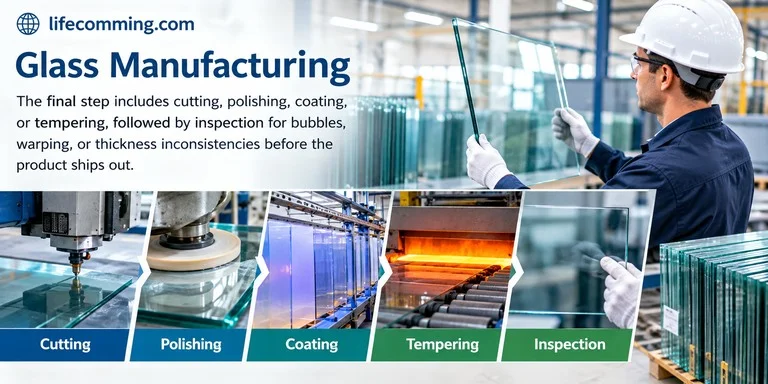
These get heated to around 2,700°F until they melt into a thick liquid. The molten glass is shaped, usually by the float process, poured onto a bed of molten tin. The tin bed makes the glass perfectly flat and smooth on both sides as it cools.
This method was developed in the 1950s. It explains why almost all modern window and mirror glass has a flawless, distortion-free surface that helps minimize distortions. The process remains widely used across the glass industry today. This reliability supports consistent quality.
When this matters to you: If you’re buying glass and a supplier mentions “float glass,” that’s a good sign. It signals standard, high-quality flat glass rather than older, less consistent methods like sheet glass, which can have slight waves or distortions.
Types of Transparent Glass and What Each One Is Best For
Not all clear glass is built the same. Here’s how the main types stack up.
- Annealed (standard) glass – The basic, untreated form. It’s the cheapest option but breaks into large, sharp shards. Good for picture frames, decorative pieces, and low-risk indoor uses where breakage isn’t a safety concern.
- Tempered (safety) glass – Heated and rapidly cooled to make it four to five times stronger than annealed glass. When it breaks, it crumbles into small, dull pebbles instead of sharp shards. Required by building codes for shower doors, glass tabletops, and car side windows.
- Laminated glass – Two glass layers bonded around a plastic interlayer (usually PVB). If it breaks, the pieces stick to the plastic instead of scattering. This is what’s used in windshields and in hurricane-resistant or forced-entry-resistant windows.
- Low-E (low-emissivity) glass – Coated with an ultra-thin, invisible metallic layer that reflects heat while still letting light through. It keeps homes cooler in summer and warmer in winter without noticeably changing how the glass looks. Common in modern replacement windows.
- Borosilicate glass – Made with boron trioxide instead of standard soda-lime formulas, which makes it highly resistant to thermal shock. This is the glass in your oven-safe bakeware and most lab equipment, since it won’t crack from sudden temperature changes.
- Tinted or reflective glass – Standard glass with added metal oxides or coatings that reduce glare and solar heat. Popular for storefronts and office buildings where cutting sunlight matters more than perfect clarity.
Quick comparison for common projects:
| Project | Best Glass Type | Why |
|---|---|---|
| Shower enclosure | Tempered | Breaks safely, handles daily impact |
| Kitchen bakeware | Borosilicate | Survives oven-to-counter temperature swings |
| Storm-prone window | Laminated | Stays intact even when cracked |
| Energy-efficient window | Low-E coated | Cuts heat transfer without blocking light |
| Picture frame | Annealed | Inexpensive, no safety risk |
Transparent vs. Translucent vs. Opaque Glass: What’s the Actual Difference
People mix these terms up constantly, and it matters when you’re shopping.
- Transparent glass lets light and images pass through clearly. You can read a book through it.
- Translucent glass (like frosted or etched glass) lets light through but scatters it, so shapes blur and details disappear. Think bathroom windows.
- Opaque glass blocks light entirely, often through heavy tinting, painted backing, or dense frosting.
The difference comes down to surface texture and internal structure, not the base material. Frosted glass starts as ordinary transparent glass. A sandblasting or acid-etching process roughens the surface at a microscopic level, scattering light instead of letting it pass straight through.
Why it matters: If you want privacy without losing natural light, translucent glass beats curtains or blinds because it still brightens the room. If you want privacy and light are secondary, opaque or heavily tinted glass makes more sense.
Common Uses of Transparent Glass by Industry
- Architecture and construction – windows, curtain walls, skylights, glass railings, and storefronts
- Automotive – windshields (laminated), side and rear windows (tempered)
- Interior design – shelving, tabletops, room dividers, cabinet doors
- Consumer products – drinkware, eyewear lenses, phone screens (using chemically strengthened glass like Gorilla Glass)
- Scientific and medical – lab beakers, test tubes, microscope slides, thermometers
- Aquariums and terrariums – tempered or laminated glass rated for constant water pressure
- Greenhouses – horticultural glass optimized to transmit specific light wavelengths that plants use for photosynthesis
Each use case pushes a different property of glass to the front: strength for cars, thermal stability for lab work, optical purity for lenses, and pressure resistance for aquariums.
How to Choose the Right Transparent Glass for Your Project
Ask these four questions before you buy:
- What’s the risk if it breaks
- High-traffic or high-impact areas (showers, tabletops, railings) need tempered or laminated glass, not standard annealed glass.
- Will it face temperature swings
- Ovens, fireplaces, and lab settings call for borosilicate glass.
- Do you need energy efficiency
- Low-E coatings pay for themselves over time on exterior windows in most US climates.
- How much clarity do you actually need
- If privacy matters more than a perfect view, translucent or tinted glass may serve you better than premium clear glass.
A cost tip most buyers miss: Glass thickness matters as much as glass type. A thicker pane of standard tempered glass can sometimes outperform a thinner pane of a “premium” type at a lower total cost. Always ask suppliers for the thickness spec, not just the glass category.
Caring for and Maintaining Transparent Glass
- Clean with a microfiber cloth and a mix of water and a few drops of dish soap; skip ammonia-based cleaners on tinted or coated glass, since they can degrade coatings over time
- Avoid abrasive sponges or powders, which create the microscopic scratches that cause hazing
- Check rubber seals and frames yearly on exterior windows, since a failed seal lets moisture in and fogs the glass permanently between panes
- For glass shelving or tabletops, use felt pads at contact points to prevent chip cracks from metal or ceramic objects
FAQs:
Is transparent glass the same as clear glass?
Yes, “transparent” and “clear” are used interchangeably to describe glass you can see through without distortion. Some clear glass has a faint green tint from natural iron content unless it’s made with low-iron formulas.
What makes glass transparent at a molecular level?
Glass atoms are arranged randomly instead of in a repeating crystal pattern. This disordered structure lets light pass through without scattering, which is what creates transparency.
Can transparent glass be made shatterproof?
Not completely shatterproof, but laminated and tempered glass are both far more break-resistant than standard glass, and laminated glass stays intact even when cracked because of its plastic interlayer.
Why does some glass look greenish on the edges?
That’s from iron oxide impurities in standard sand. Low-iron (sometimes called “ultra-clear”) glass removes most of this impurity for a more neutral, colorless look, often used in high-end display cases and aquariums.
Is tempered glass stronger than regular glass?
Yes. Tempered glass is roughly four to five times stronger than annealed glass of the same thickness, thanks to the rapid heating and cooling process that puts its surface under compression.
Does transparent glass block UV rays?
Standard clear glass blocks most UVB rays but lets a significant portion of UVA rays through, which is why prolonged sun exposure through a window can still cause fading or skin aging. Laminated glass blocks UV rays far more effectively because of its plastic interlayer.
Final Thoughts:
Transparent glass looks simple, but the right choice depends entirely on what you’re building, where it’s going, and what risks matter most. A shower door and a lab beaker are both “clear glass,” yet they’re engineered for completely different jobs.
Before your next purchase, match the glass type to your actual use case using the comparisons above, not just the price tag. If you’re working on a specific project, feel free to share the details. A more tailored recommendation is easy to work out once we know the exact application.
About the Author