Are you looking for clear information about Safety Glass and how it protects what matters most?
Whether you’re a homeowner planning renovations, a contractor sourcing materials, or a business owner upgrading security.
Additionally, this guide covers Safety Glass.
Safety glass is engineered to provide superior protection and peace of mind.
Unlike ordinary glass, it’s designed to resist shattering and minimize injury risk, making it a smart choice for windows, doors, and countless other applications.
We’ve covered everything you need to know from tempered and laminated options to the latest safety standards so you can make an informed decision with confidence.
Whether you need it for residential safety, commercial security, or industrial applications, you’ll find the right solution here.
So let’s dive in because when it comes to protecting your space, safety glass makes all the difference.
What Is Safety Glass, Exactly
- Safety glass is glass that’s been treated or constructed so it breaks in a less dangerous way than regular annealed (standard) glass.
- Regular glass shatters into long, jagged shards — the kind that cause deep lacerations.
- Safety glass either crumbles into small, dull-edged granules or cracks while staying held together in one sheet.
- In the U.S., safety glass must meet performance standards set by ANSI Z97.1 (for buildings) or the federal Consumer Product Safety Commission’s rule, 16 CFR 1201 (for hazardous locations like doors and low windows).
The name is a little misleading. No safety glass is unbreakable. The goal isn’t to prevent breakage — it’s to make breakage survivable.
Why Safety Glass Matters More Than Most People Realize
Glass injuries used to be common enough that building codes eventually stepped in. Sliding doors, shower enclosures, and low windows are exactly where people fall, walk, or get pushed into glass without warning. A few reasons this actually matters:
- Injury prevention. Tempered and laminated glass dramatically cut the risk of deep cuts and impalement injuries compared to annealed glass.
- Code compliance. Most residential and commercial buildings legally require safety glazing in specific “hazardous locations” — skip it, and you can fail inspection or void insurance coverage.
- Property protection. Laminated safety glass resists forced entry far better than standard glass, which is why it shows up in storefronts and ground-floor windows.
- Peace of mind. If you’ve got kids, pets, or a habit of walking into your own sliding door at 2 a.m., safety glass is the difference between a bruise and a hospital bill.
The Main Types of Safety Glass
There isn’t just one “safety glass.” Different situations call for different types, and mixing them up is one of the most common — and expensive — mistakes homeowners and contractors make.
Tempered Glass
- Made by heating glass to around 1,148°F and then rapidly cooling it, a process called quenching.
- This creates surface compression that makes the glass about four times stronger than regular glass of the same thickness.
- When it finally breaks, it shatters into small, granular chunks instead of shards — this is the “safety” part.
- Used in shower doors, car side and rear windows, oven doors, glass tabletops, and most sliding patio doors.
- Cannot be cut, drilled, or resized after tempering — any hole or notch has to be specified before the glass goes into the furnace.
Laminated Glass
- Made by bonding two or more layers of glass together with a tough plastic interlayer, usually polyvinyl butyral (PVB).
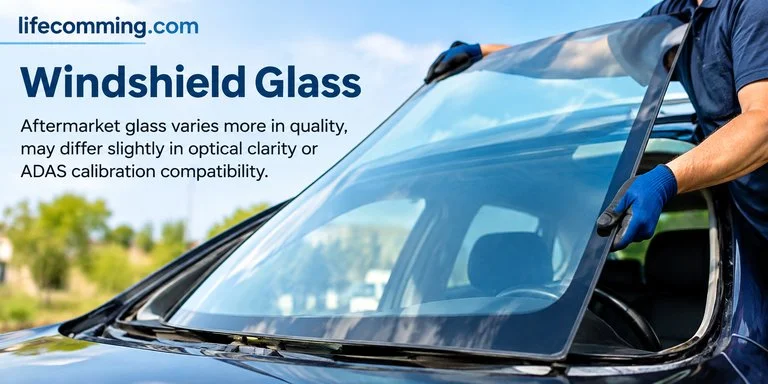
- When it breaks, the pieces stay stuck to the interlayer instead of falling apart — think of a cracked car windshield that still holds its shape.
- Offers strong resistance to forced entry, which is why it’s common in storefronts, skylights, and hurricane-zone windows.
- Also blocks a significant amount of UV light and reduces outside noise better than tempered glass.
- Used for windshields, skylights, hurricane-resistant windows, and security glazing in banks and retail storefronts.
Wired Glass
- Standard glass with a wire mesh embedded inside it during manufacturing.
- The wire doesn’t make the glass stronger — it holds broken pieces together, mainly for fire-rated applications.
- Historically used in schools and stairwells, but it actually causes worse cuts than plain tempered glass because the mesh can act like a cheese grater on impact.
- Modern fire-rated glass-ceramic products have largely replaced wired glass in new construction because they meet both fire codes and true safety glazing standards.
Vacuum Insulating Glass (VIG)
- A newer category, now formally addressed in the 2026 update to ANSI Z97.1.
- Two glass panes are hermetically sealed with a narrow vacuum gap between them, held apart by tiny spacer pillars.
- Offers strong insulation performance in a much thinner package than traditional double-pane units.
- Under the updated standard, VIG must be tested as a complete assembled unit, and depending on whether it breaks like laminated or tempered glass, it gets classified accordingly
Wire-Free Alternatives and Organic-Coated Glass
- Organic-coated glass applies a plastic film to one or both sides of annealed glass to hold fragments together on impact.
- Cheaper than laminated glass but generally less durable over time.
- Common in retrofits where replacing the whole window isn’t in the budget.
Tempered vs. Laminated: Quick Comparison
| Feature | Tempered Glass | Laminated Glass |
|---|---|---|
| Break pattern | Small granular pieces | Cracks but stays intact |
| Forced-entry resistance | Low to moderate | High |
| UV/noise reduction | Minimal | Strong |
| Post-manufacture cutting | Not possible | Possible in some cases |
| Typical use | Shower doors, patio doors, tabletops | Windshields, storefronts, skylights |
| Relative cost | Lower | Higher |
If someone’s choosing between the two for a home project, the short version: pick tempered for everyday impact zones like showers and sliding doors, and pick laminated when security, UV protection, or sound reduction matters more.
Where Building Codes Require Safety Glass
Codes don’t require safety glazing everywhere — just in spots where people are statistically likely to run into, fall through, or get pushed into glass. The International Building Code (IBC) and International Residential Code (IRC) both define these “hazardous locations.” Common examples include:
- Glass in and around doors, including sliding and swinging doors, within 24 inches of the door edge.
- Shower and tub enclosures, including any glass within 60 inches of the shower floor.
- Windows where the bottom edge sits less than 18 inches off the finished floor and the glass is larger than 9 square feet.
- Glass adjacent to stairways, ramps, and landings within 36 inches horizontally of a walking surface.
- Glazing in guardrails and structural balustrades.
Every piece of qualifying safety glazing has to carry a permanent mark showing the manufacturer, the applicable standard, the size classification, and the drop height class it was tested to that little etched logo in the corner of your shower door isn’t decoration, it’s proof of compliance. Not all tempered or laminated glass automatically counts as safety glazing either; it only qualifies once it has actually passed the required impact testing under 16 CFR 1201 or ANSI Z97.1
If you’re renovating and you’re not sure whether a spot counts as a “hazardous location,” ask your local building inspector before you order glass. It’s a five-minute phone call that can save you from re-ordering an entire window.
How Much Does Safety Glass Cost
Prices shift with size, thickness, and local labor rates, but here’s a general range for U.S. installations:
- Tempered glass: roughly $10–$25 per square foot installed for standard residential thicknesses.
- Laminated glass: roughly $20–$45 per square foot, reflecting the extra interlayer material and processing.
- Wired or fire-rated glass: often $30–$60 per square foot due to specialized fabrication.
- Custom shapes or tinted/Low-E coatings: add 15–30% on top of base pricing.
- 😉Tough as glass? More like tougher than glass
A standard tempered shower door panel typically lands somewhere between $150 and $400 depending on size and hardware. A laminated storefront window can run into the thousands once framing and installation labor are added.
How to Choose the Right Safety Glass for Your Project
- Start with the code requirement, not personal preference. If the location falls under a hazardous zone, the glass has to be tested safety glazing no exceptions for “it looks fine.”
- Match the glass to the threat. Worried about break-ins? Laminated. Worried about someone falling into it? Tempered is usually sufficient and cheaper.
- Factor in noise and heat. Laminated glass with a thicker interlayer cuts outside noise noticeably — worth it if the window faces a busy street.
- Check the marking before installation. A missing or illegible safety mark can fail inspection even if the glass itself is genuinely tempered or laminated.
- Ask about post-installation changes. If there’s any chance you’ll need to drill or cut the glass later — for hardware, vents, anything — that decision has to be made before it’s tempered.
A Little Glass Humor (Because Why Not)
Why did the safety glass go to therapy? It had trouble expressing its feelings without shattering everyone’s expectations.
Two panes of laminated glass got married. Through thick and thin, they stuck together — literally, thanks to the interlayer.
A guy walked into a glass door at the gym. Everyone panicked. Turned out it was tempered — so instead of an ambulance, he just needed a broom and his dignity back.
FAQs:
Is safety glass the same as tempered glass?
No. Tempered glass is one specific type of safety glass. Laminated, wired, and vacuum insulating glass are also categories of safety glazing, each breaking or holding together differently.
Can safety glass still break?
Yes. Safety glass is designed to break more safely, not to be unbreakable. Tempered glass shatters into small granules, and laminated glass cracks but stays adhered to its interlayer.
How do I know if my window is safety glass?
Look in the corner of the pane for an etched or printed mark — usually something like “ANSI Z97.1” or “CPSC 16 CFR 1201,” along with the manufacturer’s name and thickness code.
Is laminated glass bulletproof?
Standard laminated glass is not bulletproof. Bullet-resistant glass uses much thicker, multi-layer laminated construction specifically rated for ballistic testing — a different product category entirely.
Do shower doors legally have to be safety glass?
Yes, in nearly all U.S. jurisdictions. Building codes classify shower and tub enclosures as hazardous locations, requiring tempered or laminated safety glazing regardless of the glass size.
Why was wired glass banned in some places?
Wired glass still has to pass the same ANSI Z97.1 testing as any other safety glazing when it’s used in a hazardous location and because the embedded wire can worsen cuts on impact, many schools and public buildings have phased it out in favor of fire-rated ceramic glazing that meets both fire and safety codes.
Final Thoughts:
Safety glass isn’t just a code checkbox it’s one of those quiet design decisions that only matters the one day something goes wrong. Whether you’re replacing a shower door, finishing a basement window, or building out a storefront, matching the right type of safety glass to the right location keeps you compliant, keeps your project safer, and honestly, saves you a very unpleasant trip to urgent care.
About the Author



1 thought on “220+ Safety Glass: The Complete Guide to Types, Codes, and Choosing the Right One”