Walk into any building with real character a century-old bank lobby, a boutique hotel, a neighbor’s front door that makes you stop and stare and there’s a good chance decorative glass is doing the heavy lifting.
It turns a plain pane into a design statement without adding bulk, blocking light, or requiring a full renovation.
This guide covers every major type of decorative glass, where each one works best, what it actually costs, and how to avoid the most common buying mistakes.
No fluff, no filler just what you need to choose with confidence.
What Is Decorative Glass
Decorative glass is any glass that’s been treated, textured, colored, or shaped to serve a design purpose beyond simply letting light through. Manufacturers create the effect through etching, sandblasting, coloring, layering, or physically molding the glass while it’s still hot.
Unlike a plain flat pane, decorative glass does three jobs at once:
- Filters or diffuses light instead of just passing it through
- Adds privacy without needing curtains, blinds, or frosted film
- Functions as a visual feature a piece of art that’s also structural
It shows up in windows, doors, room dividers, cabinet fronts, shower enclosures, tabletops, and even kitchen backs plashes.
Why Decorative Glass Matters More Than People Realize
Most homeowners think of decorative glass as purely cosmetic. That undersells it. The right glass choice solves real, practical problems.
Privacy without darkness. A frosted or reeded bathroom window keeps the room bright while blocking the view completely something a curtain can’t do without also cutting the light.
Energy performance. Many decorative glass units are made with double or triple panes, which means the decorative layer doesn’t have to come at the cost of insulation.
Property value. A well-executed stained glass transom or an etched front door panel is the kind of detail buyers remember after touring a dozen similar houses.
Damage disguise. Textured and frosted glass hide fingerprints, water spots, and light scratches far better than clear glass — a genuine advantage in high-traffic spots like entry doors and shower panels.
Main Types of Decorative Glass (And Where Each One Shines)
There’s no single “best” decorative glass the right pick depends on how much privacy you need, how much light you want, and the look you’re going for.
Frosted Glass
Frosted glass gets its cloudy, matte finish from acid etching or sandblasting, which roughens the surface so light scatters instead of passing straight through.
- Best for: bathroom windows, office partitions, shower doors
- Light transmission: high; privacy: high
- Typical cost: $30–$70 per square foot installed
Etched Glass
Etching uses acid or a sandblaster to cut a permanent pattern, monogram, or scene into the surface. It ranges from a simple border to an elaborate custom design.
- Best for: entry doors, cabinet inserts, business signage on glass doors
- Light transmission: high; privacy: moderate to high depending on pattern density
- Typical cost: $40–$150 per square foot for custom work
Stained Glass
Stained glass is made from individually colored pieces joined with lead or copper foil came. It’s the most labor-intensive option and the one most people picture when they hear “decorative glass.”
- Best for: front door sidelights, transoms, church and heritage restoration, statement windows
- Light transmission: moderate, filtered through color; privacy: high
- Typical cost: $200–$400+ per square foot for hand-crafted pieces
Leaded Glass
Leaded glass uses the same came-and-solder technique as stained glass but typically stays clear or lightly tinted, focusing on geometric pattern rather than color.
- Best for: traditional or Tudor-style homes, cabinet doors, formal dining rooms
- Light transmission: high; privacy: low to moderate
- Typical cost: $150–$300 per square foot
Textured Glass (Rain, Reed, Hammered, Seedy)
Textured glass is pressed or rolled while molten to create a surface pattern ripples, vertical reeds, hammered dimples, or tiny embedded “seeds” (air bubbles).
- Best for: shower enclosures, interior doors, kitchen cabinets
- Light transmission: high; privacy: moderate
- Typical cost: $25–$60 per square foot
Fused and Slumped Glass
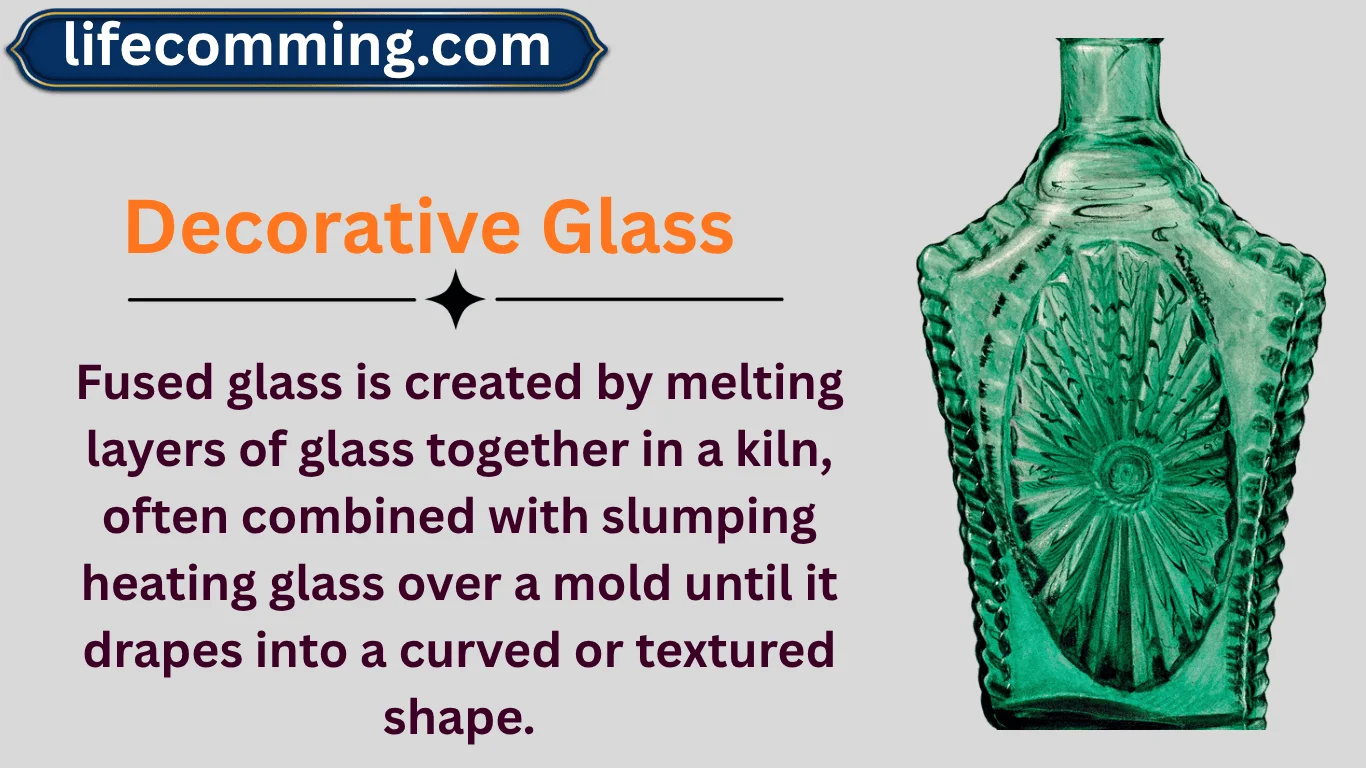
Fused glass is created by melting layers of glass together in a kiln, often combined with slumping heating glass over a mold until it drapes into a curved or textured shape.
- Best for: art panels, decorative bowls and tiles, custom feature walls
- Light transmission: variable; privacy: variable
- Typical cost: $80–$250 per square foot, highly design-dependent
Tinted and Colored Glass
Tinted glass is colored throughout the material itself (not painted or layered), giving a consistent hue with no visible seams or patterns.
- Best for: modern facades, glass partitions, tabletops, skylights
- Light transmission: moderate; privacy: low to moderate
- Typical cost: $20–$50 per square foot
Mosaic and Mirrored Glass
Mosaic glass combines small colored or mirrored pieces into a larger design, often used decoratively rather than structurally.
- Best for: backs plashes, accent walls, tabletops, small feature windows
- Light transmission: low to moderate; privacy: high
- Typical cost: $15–$40 per square foot for tile-style applications
Quick Comparison Table
| Type | Best For | Privacy Level | Typical Cost/sq ft |
|---|---|---|---|
| Frosted | Bathrooms, offices | High | $30–$70 |
| Etched | Entry doors, cabinets | Moderate–High | $40–$150 |
| Stained | Front doors, statement windows | High | $200–$400+ |
| Leaded | Traditional homes | Low–Moderate | $150–$300 |
| Textured | Showers, interior doors | Moderate | $25–$60 |
| Fused/Slumped | Art panels, feature walls | Variable | $80–$250 |
| Tinted | Facades, partitions | Low–Moderate | $20–$50 |
| Mosaic | Backsplashes, accents | High | $15–$40 |
When Should You Actually Use Decorative Glass
Decorative glass earns its cost when it solves a specific problem, not just when it looks nice in a catalog.
- You need privacy but hate blocking light a bathroom, home office, or street-facing front door are the classic cases.
- You want a focal point that doesn’t compete for floor space a stained or etched window does the work a piece of art usually does, but it’s built into the wall.
- You’re covering up an unattractive view reeded or heavily textured glass obscures a neighbor’s fence or an alley without going full opaque.
- You’re restoring a historic property leaded and stained glass are often period-appropriate in ways modern frosted film simply isn’t.
- You’re designing a commercial space etched logos on glass doors and frosted meeting-room partitions read as more polished than blinds or curtains ever will.
How to Choose the Right Decorative Glass
Picking the right style comes down to answering four questions honestly before you shop.
- How much privacy do you actually need? A fully obscured pattern (heavy frost, dense stained glass) works for bathrooms and street-facing doors. A lighter texture works for interior partitions where some visibility is fine.
- How much natural light are you willing to lose? Darker tints and dense mosaics cut more light than frosted or reeded glass.
- What’s the architectural style of the space? Leaded and stained glass suit traditional and heritage homes. Tinted and fused glass fit modern and minimalist interiors better.
- What’s your realistic budget? Custom stained or fused glass costs several times more than machine-textured or frosted glass, and that gap is almost entirely about labor, not materials.
Installation: die vs. Hiring a Professional
Some decorative glass projects are approachable for a confident DIYer. Others genuinely require a trained glazier.
Reasonable die projects:
- Applying frosted or decorative window film (not true decorative glass, but a budget alternative)
- Installing pre-made decorative glass cabinet inserts
- Small mosaic tile accents using pre-cut glass tile
Projects that call for a professional:
- Any exterior window or door replacement, due to weatherproofing and structural requirements
- Custom stained or leaded glass, which requires specialized soldering and framing skills
- Large shower enclosures, where precise measurement prevents leaks and code violations
- Etched or sandblasted glass, since mistakes on custom patterns can’t be undone
A botched die install on an interior cabinet panel is a minor annoyance. A botched die install on an exterior door is a safety and water-intrusion risk. Match your ambition to the stakes.
Caring for Decorative Glass
Decorative glass generally needs gentler care than plain glass, because textured and etched surfaces trap dust and fingerprints differently.
- Use a soft microfiber cloth and a mild, ammonia-free glass cleaner — ammonia can dull etched and painted surfaces over time
- Avoid abrasive sponges or scrubbing pads on frosted or sandblasted finishes; they can polish away the matte texture unevenly
- Clean textured glass with a soft-bristle brush dipped in soapy water to reach into grooves and ripples
- Reseal exterior stained or leaded glass panels every few years to prevent moisture from reaching the lead came
- Check putty and caulking annually on older leaded windows, since dried-out seals are the most common cause of panel sagging
Common Mistakes to Avoid
- Choosing pattern before privacy needs. A gorgeous etched design that still shows a silhouette through the glass isn’t a fix for a street-facing bathroom window.
- Ignoring building codes. Bathrooms and areas near stairs or doors often require tempered or safety-rated decorative glass — always confirm before ordering custom work.
- Underestimating lead time. Custom stained and etched glass can take four to ten weeks to fabricate; ordering it the week before an event is a common regret.
- Mixing too many styles in one space. One or two decorative glass features per room reads as intentional design. Five different textures in five different windows reads as leftover inventory.
FAQs:
What is the most affordable type of decorative glass?
Frosted, tinted, and machine-textured glass (like rain or reeded patterns) are generally the most budget-friendly, since they’re mass-produced rather than hand-crafted piece by piece.
Is decorative glass as strong as regular glass?
It depends on the type and thickness. Tempered decorative glass is just as strong as tempered clear glass. Leaded and stained glass panels are more fragile because the came (the metal strip joining pieces) is softer than the glass itself.
Can decorative glass be used outdoors?
Yes, but exterior applications need weather-rated, tempered, or laminated glass. Traditional lead-came stained glass is more common in protected exterior spots like covered porches or storm-window-backed installations.
Does decorative glass block UV rays?
Some does. Tinted and certain laminated decorative glass types reduce UV transmission significantly, which helps protect flooring and furniture from fading. Clear frosted or etched glass offers little to no UV protection unless a UV-filtering interlayer is added.
How long does decorative glass last?
Quality decorative glass, properly installed and maintained, commonly lasts 20 to 50+ years. Stained glass with well-maintained lead came can last over a century, which is why so many original church and Victorian-era windows still exist today.
Can you add decorative glass to an existing plain window?
Sometimes. Small decorative inserts and applied textures can be added to existing frames. But most true decorative glass — etched, stained, leaded, or textured — needs to replace the existing pane rather than sit on top of it.
Final Thoughts:
Decorative glass isn’t one product it’s a whole category of solutions, each suited to a different mix of privacy, light, and style. A frosted bathroom window solves a completely different problem than a hand-soldered stained glass transom, even though both fall under the same label.
Start with what the space actually needs privacy, light control, or visual impact then match the glass type to that need before you fall in love with a pattern. Get that order right, and decorative glass earns its keep for decades.
About the Author