Light does something different when it passes through colored glass. It stops being just light and becomes a mood, a memory, a small piece of theater on your wall.
That’s the whole appeal of stained glass, and it’s why the craft has survived for more than a thousand years without ever really going out of style.
This guide covers everything a real person searching for “stained glass” actually wants to know:
what it is, how it’s made, what it costs, how to buy or commission a piece, how to care for one you already own, and how to get started making it yourself.
No fluff, no padding just the answers, organized the way you’d actually look for them.
What Is Stained Glass, Exactly
Stained glass is glass that’s been colored, cut, and assembled into a design, then held together with strips of lead, zinc, or copper. The color usually comes from metallic oxides mixed into the glass while it’s still molten — cobalt for blue, gold or copper for red, iron for green.
Here’s where a lot of people get confused: “stained” doesn’t mean painted on top like a coat of stain on wood. The color usually runs all the way through the glass itself. Painted details faces, folds in clothing, lettering are a separate technique added on top and then fired in a kiln to fuse permanently into the surface.
Why it matters: understanding this distinction helps you tell a genuine handmade piece from a printed or film-based imitation, which matters a lot if you’re paying real money for one.
A Quick History That Actually Explains the Craft
Stained glass windows started appearing in European churches around the 10th and 11th centuries, though colored glass itself is far older Roman and Egyptian glassmakers were coloring glass with metal oxides centuries before that.
The medieval Church used stained glass windows the way modern signage uses billboards. Most people couldn’t read, so windows told Bible stories in pictures: tall, glowing comic strips built into the architecture. Chartres Cathedral in France still has windows from the 12th and 13th centuries that have survived wars, weather, and 800 years of sunlight.
- Gothic period (12th–15th century): Large-scale narrative windows in cathedrals, driven by advances in architecture that allowed bigger window openings.
- Renaissance decline: As painting on canvas became the dominant art form, stained glass work slowed down and got less experimental.
- Victorian revival (19th century): Architects like Augustus Pugin and artists connected to the Arts and Crafts movement brought the craft roaring back, this time into homes, not just churches.
- Art Nouveau and Tiffany era (late 1800s–early 1900s): Louis Comfort Tiffany pioneered “favrile” glass and the copper foil method, moving stained glass from cathedral windows into lamps and residential doors.
- Modern era: Contemporary stained glass shows up in everything from sun-catchers to airport installations, using both traditional lead work and newer techniques like glass fusing.
Why this history matters to you today: it explains the two dominant construction methods you’ll encounter when shopping leaded came (the old cathedral method) and copper foil (the Tiffany method) — and why they look and cost differently.
How Stained Glass Is Actually Made
Knowing the process helps you judge quality and understand why handmade pieces cost what they do. Here’s the general workflow a studio follows:
- Design the pattern: The artist creates a full-size drawing called a cartoon, mapping out every piece of glass and where the lead lines will go.
- Select and cut the glass: Sheets of colored glass are cut into the exact shapes from the pattern, using a glass cutter and running pliers to snap along the score line.
- Grind the edges: Each piece gets ground smooth on a wet grinder so it fits its neighbors precisely.
- Paint and fire details (if needed): Fine details like faces or shading are hand-painted with glass paint, then fired in a kiln at around 1,200–1,300°F to permanently bond the paint to the glass.
- Assemble with came or foil: For leaded work, H-shaped lead strips (came) are fitted around each piece and soldered at the joints. For copper foil work, thin copper tape wraps each piece’s edge, and solder is flowed over the tape to bond everything.
- Waterproof and finish: A putty or cement compound is worked into the gaps to weatherproof the piece, and the metal is patinaed to a black, copper, or antique finish.
A single square foot of detailed stained glass can take an experienced artist several hours to a full day, which is the honest answer to “why is stained glass so expensive.”
Leaded Came vs. Copper Foil: Which Method Is Right for Your Project
This is one of the most practical decisions in the entire craft, and most buying guides skip it. Here’s the real comparison.
| Feature | Leaded Came | Copper Foil (Tiffany Method) |
|---|---|---|
| Best for | Windows, large panels, geometric patterns | Lamps, small panels, curved and detailed designs |
| Line thickness | Thicker, more visible lines | Thin, delicate lines |
| Structural strength | Very strong for large flat panels | Strong for smaller or 3D shapes like lamp shades |
| Historical feel | Traditional, cathedral-style look | Art Nouveau, decorative look |
| Difficulty for beginners | Moderate — fewer tiny pieces typically | Higher — more fiddly wrapping and soldering |
If you’re commissioning a window, ask which method the studio plans to use and why a good studio will have an opinion, not just a default.
Types of Stained Glass Projects (Beyond Church Windows)
Most people picture cathedrals, but stained glass shows up in far more places today.
- Residential windows: Entryway sidelights, bathroom privacy windows, and transom windows above doors.
- Doors: Front doors with stained glass inserts remain one of the most popular home upgrades because they boost curb appeal without sacrificing privacy.
- Lamps and lighting: Tiffany-style lamps use hundreds of small glass pieces over a curved copper form.
- Suncatchers and small decor: A common entry point for hobbyists and a popular handmade gift.
- Cabinet and furniture inserts: Kitchen cabinets and built-ins sometimes use stained or textured glass panels instead of solid wood doors.
- Memorial and commemorative pieces: Custom panels made to honor a person, pet, or milestone, often combining symbolism with a client’s personal story.
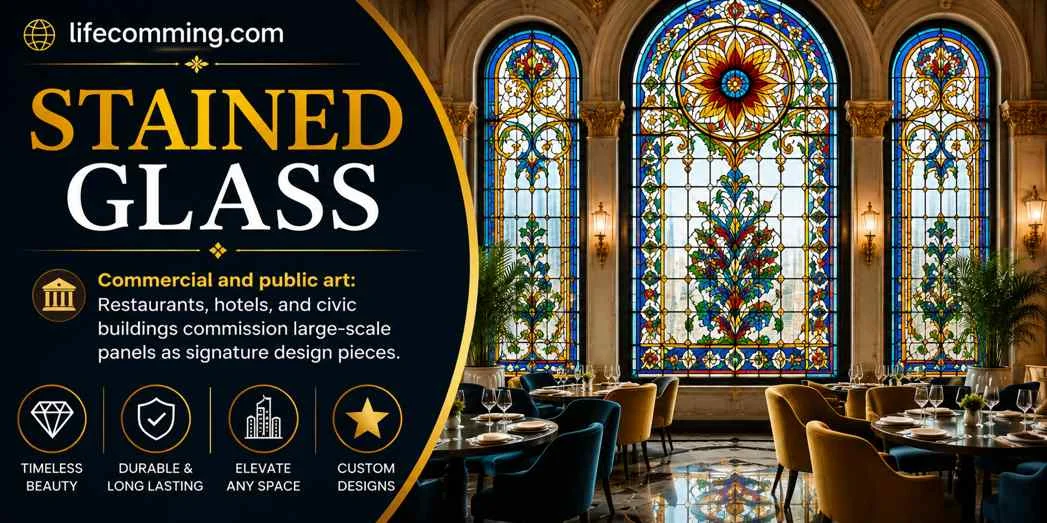
- Commercial and public art: Restaurants, hotels, and civic buildings commission large-scale panels as signature design pieces.
How Much Does Stained Glass Cost
Cost depends on size, complexity, glass quality, and whether it’s handmade or mass-produced. Here’s a realistic range based on typical studio and retail pricing patterns:
- Small sun-catchers or decorative pieces: roughly $30–$150, depending on detail level.
- Custom window panels: often $100–$300 per square foot for handmade work, more for intricate figurative designs.
- Front door inserts: commonly $500–$3,000+ depending on size and design complexity.
- Tiffany-style lamps: anywhere from $150 for smaller reproduction pieces to several thousand dollars for large, historically accurate reproductions or antiques.
- Church or large architectural windows: can run into the tens of thousands of dollars for large, multi-panel commissions.
Why it matters: understanding these ranges helps you spot a fair quote versus an inflated one, and helps you budget realistically before you start shopping.
Real Stained Glass vs. Fake: How to Tell the Difference
A lot of “stained glass” sold online is actually a printed film or a plastic overlay designed to mimic the look. Here’s how to check before you buy:
- Look at the edges: Real glass pieces have slightly visible seams where individual pieces meet the lead or foil. A printed film has no seams it’s one continuous sheet.
- Check for texture: Authentic glass often has texture, bubbles, or slight color variation (called “streakiness”) because it’s handmade. Printed versions look perfectly uniform.
- Feel the surface: Run a hand over it. Real leaded lines have a slight raised ridge; printed lines are flat.
- Hold it to a light source: Genuine stained glass changes intensity and hue slightly as the light angle changes, because the glass itself has depth. Film stays flat and consistent.
- Ask about the maker: A legitimate studio can tell you their process, the glass supplier, and roughly how long the piece took to make.
Caring for Stained Glass: Cleaning and Maintenance
Stained glass is more delicate than regular window glass because of the metal joints holding it together. Treat it gently and it will easily outlast you.
- Dust regularly with a soft, dry brush or microfiber cloth to prevent grime buildup in the grooves along the lead lines.
- Clean with a mild solution of water and a few drops of dish soap, applied with a soft cloth — never ammonia-based glass cleaners, which can corrode lead and copper over time.
- Avoid high-pressure water or hoses, especially on exterior windows, since force can loosen aging solder joints.
- Check the putty and lead lines every few years for cracking, bowing, or gaps, especially on older or exterior pieces exposed to weather.
- Support large panels properly with reinforcing rebar bars (common in professional installations) so the glass doesn’t sag under its own weight over decades.
- Keep panels out of direct, prolonged extreme heat when possible, since major temperature swings stress both the glass and the metal came.
A well-maintained leaded panel can last well over a century — plenty of Victorian-era windows are still intact today, proof that with basic care, this isn’t a fragile decoration but a durable art form.
Repairing Stained Glass: When to DIY and When to Call a Pro
Small cosmetic issues are fine to handle yourself. Structural problems are not.
- Fine to DIY: Cleaning, re-cementing a slightly loose piece, touching up patina on solder lines.
- Call a professional: Cracked individual glass pieces, bowing panels, broken solder joints, or any window that’s structurally load-bearing (like an exterior architectural window).
- Red flag to watch for: a panel that visibly bulges or sags in the middle usually means the internal support has failed, and delaying repair risks the whole piece collapsing.
Most stained glass studios offer repair services even if they didn’t make the original piece, so you don’t need to track down the original artist.
Getting Started With Stained Glass as a Hobby
If the craft itself interests you, it’s more approachable than it looks. Beginners typically start with the copper foil method because the tools are cheaper and the learning curve is gentler for small projects like sun-catchers.
- Starter tool kit: glass cutter, running pliers, grinder, soldering iron, flux, foil tape, and safety glasses.
- First project recommendation: a simple geometric suncatcher with fewer than 10 pieces, before attempting curved or figurative designs.
- Where to learn: many local art centers and community colleges offer beginner stained glass classes, which are worth taking before investing in a full home setup.
- Budget for starting out: a basic beginner kit with tools and glass scraps runs roughly $100–$250.
Why it matters: trying the craft yourself, even briefly, gives you a much better eye for judging quality when you eventually buy or commission a professional piece.
Symbolism and Meaning in Stained Glass Design
Stained glass carries meaning beyond decoration, which is part of why people commission custom pieces for meaningful spaces.
- Circles and rose windows traditionally represent wholeness, eternity, or the divine, which is why they appear so often above cathedral entrances.
- Specific colors carry traditional associations — blue often symbolizes heaven or truth, red for sacrifice or passion, green for growth or renewal — though modern designers use color more freely and personally.
- Nature motifs like vines, birds, and florals became especially popular during the Art Nouveau period and remain a common choice for residential pieces today.
- Geometric patterns are popular in modern secular design because they read as elegant without carrying specific religious symbolism.
FAQs:
Is stained glass expensive to maintain?
No. Basic care is just occasional gentle dusting and mild soap-and-water cleaning. The cost concern with stained glass is almost always upfront purchase or commission price, not ongoing maintenance.
Can stained glass be installed in exterior windows?
Yes, and it commonly is, but exterior pieces need extra weatherproofing and usually a protective storm window or laminated backing to guard against wind pressure and impact.
How long does stained glass last?
Well-made pieces routinely last 100+ years. The glass itself doesn’t degrade; the metal came or foil eventually needs releading or resoldering after many decades of exposure.
What’s the difference between stained glass and mosaic glass art?
Stained glass pieces are cut to fit together with almost no gaps, joined by lead or foil lines that are part of the design. Mosaics use small, often irregular glass pieces set into grout, with the gaps themselves as part of the visual texture.
Is stained glass heavy?
Yes, more than people expect. A large leaded panel can weigh several pounds per square foot, which is why big installations need proper structural framing and support bars.
Can you repair a single cracked piece without redoing the whole panel?
Usually yes. A skilled restorer can cut out just the damaged piece and fit a matching replacement without disturbing the rest of the panel, as long as the surrounding lead lines are still sound.
Does stained glass fade over time?
The glass color itself doesn’t fade, since the color is embedded in the material. Painted details can wear faintly over centuries of UV exposure, which is why cathedral restoration projects sometimes need to refire or replace painted sections.
Final Thoughts:
Stained glass isn’t a relic sitting behind velvet ropes in old churches it’s a living craft that fits just as naturally into a front door, a reading lamp, or a kitchen cabinet as it does into a cathedral.
Whether you’re buying a piece, commissioning something custom, or picking up a glass cutter for the first time, understanding how it’s made and cared for is what separates a good decision from an expensive regret.
About the Author




1 thought on “300+ Stained Glass Decoded: Windows to Your Door”