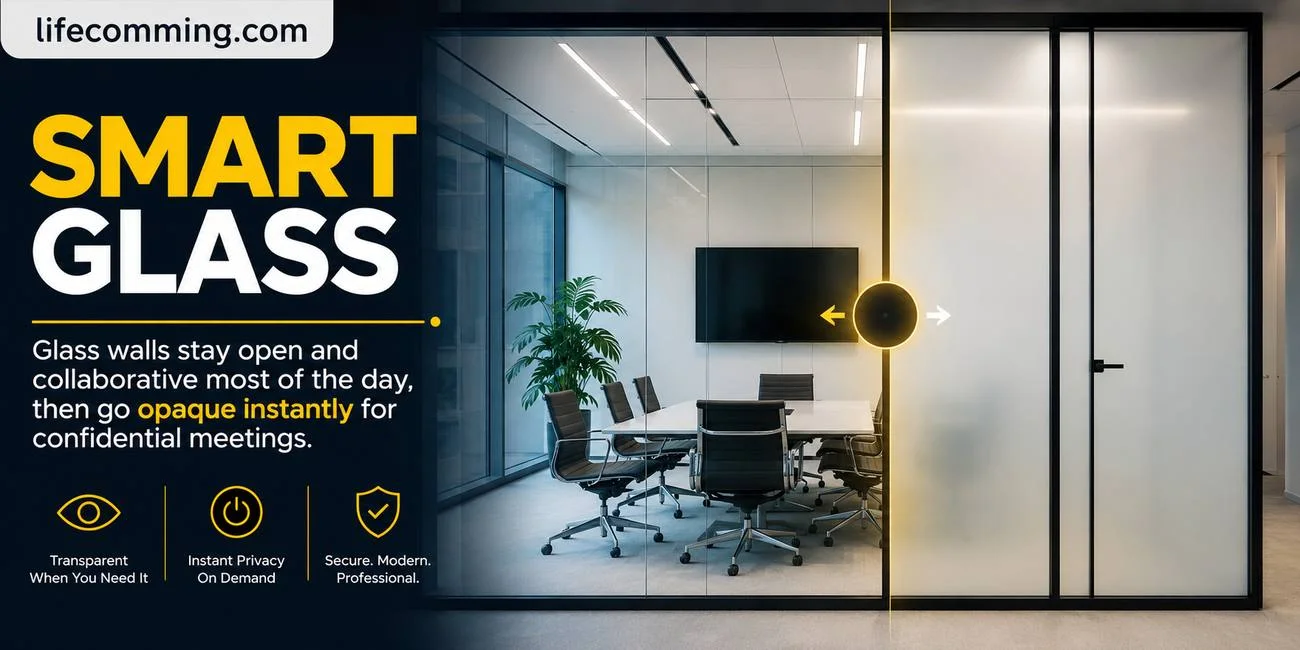
Smart glass, also known as switchable glass or electrochromic glass, has become an innovative solution in modern architecture and design.
Engineered with advanced technology, this glass can change its transparency in response to electrical signals, light, or heat.
Unlike traditional glass, it allows users to control privacy and light levels instantly.
No need for blinds or curtains.
The result? Enhanced convenience, energy efficiency, and a futuristic touch to any space.
Smart glass also plays a key role in reducing heat gain and glare.
This helps lower cooling costs in sunlit rooms.
Its versatility makes it a popular choice for office partitions, skylights, conference rooms, and high-end residential windows.
Beyond functionality, it adds a sleek, cutting-edge aesthetic that enhances the overall value of a building.
With rising demand for energy-efficient and smart building technologies, smart glass continues to be a trusted solution across residential, commercial, and automotive industries.
It combines innovation, efficiency, and style making it a smart investment for the future of design.
What Is Smart Glass
Smart glass also called switchable glass or privacy glass is glass that changes from clear to opaque (or tinted) on command. Most versions do this using a low electrical charge; a few react to sunlight or heat instead.
It’s not the same as tinted glass or frosted glass, which are stuck in one look forever. Smart glass toggles between states, which is the whole point. You get a private, frosted window when you need privacy and a clear view the rest of the time.
- Turns from transparent to translucent or opaque in seconds to minutes
- Works as a standalone window, a laminated glass panel, or a retrofit film applied to existing glass
- Found in homes, offices, hospitals, cars, storefronts, and aircraft
How Does Smart Glass Actually Work
Most smart glass relies on a thin active layer sandwiched between two panes of glass or embedded in a film. When you apply voltage, molecules inside that layer either align (letting light through) or scatter (blocking it).
- No power = default state. Depending on the technology, “off” can mean opaque or clear this trips people up when shopping, so always ask before you buy.
- Power = switched state. A wall switch, remote, app, or automated sensor sends the current.
- Switching speed varies. Some types change in under a second; others take a few minutes to fully tint.
This matters practically: a hospital privacy wall that needs instant opacity shouldn’t use a slow-switching technology, and a sunroom chasing energy savings doesn’t need instant switching at all.
Types of Smart Glass
There isn’t one “smart glass” there are four distinct technologies, each suited to different jobs.
- PDLC (Polymer Dispersed Liquid Crystal): The most common residential and office choice. Instantly flips between clear and milky-white opaque. Great for privacy, weak for solar heat control.
- Electrochromic: Uses ions to shift the glass through shades of tint rather than full opacity. Takes a few minutes to change. Popular in office buildings and Boeing 787 aircraft windows because it manages glare and heat without blackout privacy.
- SPD (Suspended Particle Device): Sits between PDLC and electrochromic it dims quickly and offers more graduated control than PDLC, often used in car sunroofs, skylights, and yachts.
- Thermochromic and Photochromic: Passive types that react to heat or UV light with no electricity or switch at all. These tint automatically, similar to Transitions eyeglass lenses, and suit skylights or greenhouses where hands-free control matters more than on-demand privacy.
| Type | Switch Speed | Best For | Needs Power? |
|---|---|---|---|
| PDLC | Instant | Privacy walls, home offices, bathrooms | Yes, continuously |
| Electrochromic | 1–20 minutes | Office facades, aircraft, skylights | Yes, briefly to change |
| SPD | Near-instant | Car sunroofs, marine, glare control | Yes, continuously |
| Thermochromic/Photochromic | Gradual, automatic | Greenhouses, skylights | No |
Smart Glass vs. Smart Film What’s the Real Difference
People use these terms interchangeably, but they’re two different products solving the same problem.
- Smart glass panels: The switchable layer is laminated permanently between two sheets of tempered glass at the factory. It’s a full window replacement, more durable, and typically the pricier route.
- Smart film: A self-adhesive PDLC film applied directly onto glass you already own. It’s the retrofit option cheaper, faster to install, and reversible if you move or change your mind.
If you’re renovating and replacing windows anyway, factory-laminated glass makes sense. If you just want to convert an existing window or interior partition, film gets you most of the same effect for less money and no demolition.
How Much Does Smart Glass Cost in 2026
Pricing depends heavily on which technology you pick, whether you’re buying film or full panels, and who’s installing it. Based on current 2026 market pricing across major installers and manufacturers, here’s a realistic range:
| Option | Typical Cost per Sq. Ft. (Installed) |
|---|---|
| DIY smart film (material only) | $25 – $50 |
| Professionally installed PDLC film | $80 – $125 |
| Factory PDLC smart glass panels | $85 – $150 |
| Electrochromic glass | $75 – $150 |
| SPD glass | $50 – $150 |
A few things drive the final number up or down:
- Zone wiring: Each independently switched section usually needs its own driver and controller, which adds roughly $200–$500 per zone plus electrician labor.
- Certification: Legitimate powered glass carries low-voltage safety certification and impact-resistance testing uncertified imports are cheaper but fail faster and can be a genuine electrical hazard.
- Order size: Electrochromic manufacturers often have high minimum order quantities, which pushes small residential jobs toward PDLC or SPD instead.
A standard 10-by-8-foot interior office wall typically lands around $6,400–$10,000 fully installed, wiring included.
Where People Actually Use Smart Glass
Smart glass earns its keep in spaces where privacy, glare, or heat control needs to change throughout the day not spaces that need one fixed look forever.
- Home offices and bathrooms: Frosted-on-demand walls replace blinds without the dust, cords, or broken slats.
- Conference rooms: Glass walls stay open and collaborative most of the day, then go opaque instantly for confidential meetings.
- Hospitals and clinics: PDLC partitions give patients privacy during exams without full walls blocking staff sightlines.
- Storefronts and showrooms: Retailers switch window displays from showcase-clear to opaque after hours, doubling as a security and merchandising tool.
- Cars, boats, and aircraft: SPD sunroofs and electrochromic aircraft windows cut glare and heat without a physical shade.
- Skylights and greenhouses: Thermochromic glass tints automatically as the sun heats the space, no controls needed.
The Real Benefits of Smart Glass
- Instant privacy control without curtains, blinds, or films that collect dust and need replacing
- Daylight without the glare, since several technologies dim rather than fully block light
- Cleaner sightlines, since there’s nothing hanging in the window to break, warp, or get stuck
- UV and heat reduction, which can lower cooling costs in sun-heavy rooms
- A design upgrade that reads as premium in offices, model homes, and hospitality spaces
The Honest Limitations
No guide is complete without the downsides, and smart glass has real ones.
- Upfront cost is high compared to blinds or standard tinted film you’re paying for the technology, not just the glass
- It needs electricity, so a power outage or wiring fault can leave PDLC glass stuck in one state
- Repairs are specialized. A cracked panel or a failed film usually means calling the original installer, not a general glazier
- Full blackout isn’t guaranteed. Electrochromic and SPD glass tint rather than go fully opaque, so if total blackout is the goal, PDLC is the only reliable pick
How to Choose the Right Smart Glass for Your Space
Match the technology to the actual problem you’re solving, not the flashiest option.
- Need instant, total privacy. Go with PDLC it’s the only type that reliably goes fully opaque.
- Fighting glare and heat on a sunny facade. Electrochromic or SPD manage light gradually without blacking out the view entirely.
- Working with an existing window and a tight budget. Smart film retrofits get you 80% of the benefit for a fraction of the cost of full panel replacement.
- Want zero-maintenance, hands-off tinting. Thermochromic or photochromic glass needs no wiring or switch at all.
Installation and Maintenance
- DIY film can be applied by a confident homeowner in an afternoon, though bubbles and misalignment are common on a first attempt professional installation avoids this.
- Factory panels require a licensed installer and often an electrician for the low-voltage wiring; this isn’t a weekend project.
- Cleaning is simple: a soft cloth and standard glass cleaner, avoiding abrasive tools that can scratch the laminate layer.
- Lifespan for quality PDLC film and panels typically runs 10–15 years with proper installation; cheaper, uncertified products tend to haze or fail well before that.
FAQs:
Is smart glass worth the cost?
For spaces where privacy or glare genuinely changes throughout the day conference rooms, home offices, bathrooms most owners find it worth it. For a room that just needs one fixed level of privacy, standard frosted or tinted glass is cheaper and does the job just as well.
Does smart glass work without electricity?
PDLC and SPD glass need continuous power to stay in their switched state and will typically default to opaque (PDLC) or clear (SPD) if power cuts out. Thermochromic and photochromic glass need no electricity at all, since they react to heat or light directly.
Can I install smart glass myself?
Smart film can be a DIY project on a small, flat window. Full smart glass panels involve electrical wiring and professional handling of large glass sheets, so those jobs are best left to a licensed installer.
How long does smart glass last?
Well-made PDLC film and factory panels generally last 10 to 15 years. Life span depends heavily on installation quality and whether the product carries proper low-voltage safety certification.
Is smart glass the same as smart window film?
Not quite. Smart film is a retrofit product applied to glass you already have. Smart glass panels have the switchable layer laminated permanently inside new tempered glass at the factory. Both use the same underlying PDLC technology in most cases.
Does smart glass block UV rays?
Yes, most smart glass technologies block a significant share of UV light in both their clear and opaque states, which helps protect furniture and flooring from sun fading.
Final Thought:
Smart glass isn’t a gimmick it’s a genuinely useful fix for spaces that need to switch between open and private throughout the day.
The right choice comes down to matching the technology to your actual need: PDLC for full privacy on demand, electrochromic or SPD for glare and heat control, and passive thermochromic glass when you want zero maintenance.
Before you buy, get quotes from at least two installers, confirm the product carries proper safety certification, and ask directly what happens to the glass during a power outage.
About the Author



1 thought on “220+ Smart Glass: The Window Tech That Reads Your Mood”