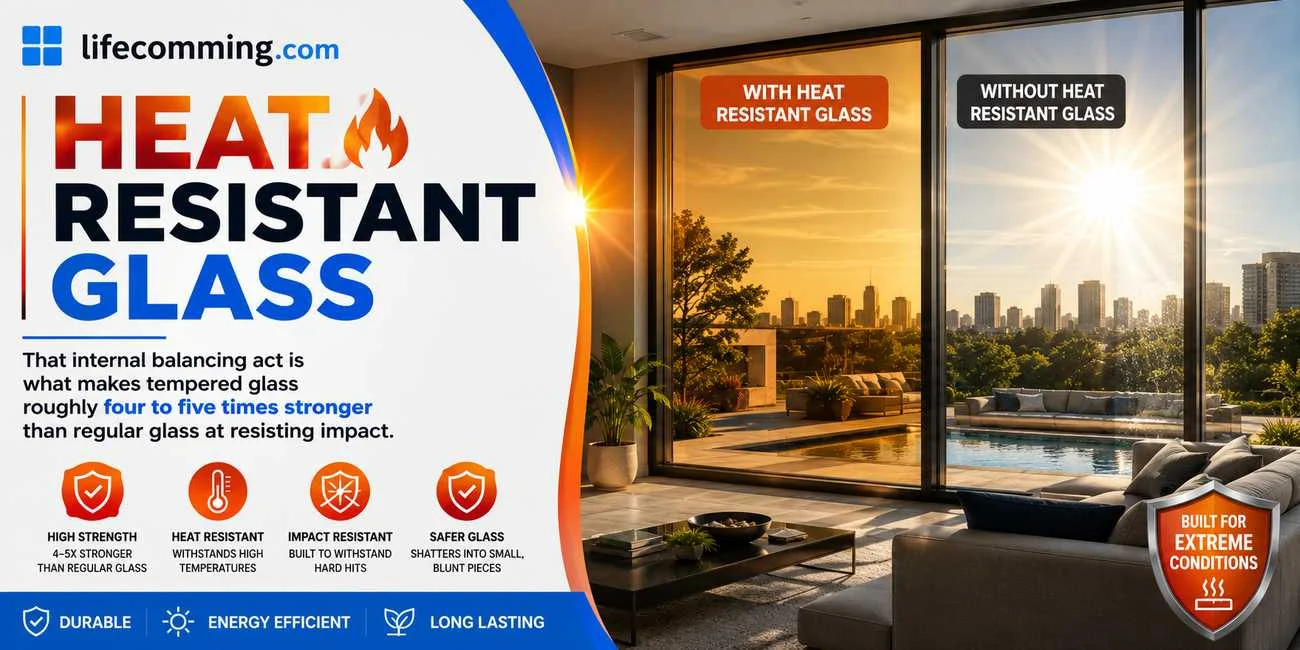
Heat resistant glass, also known as heat strengthened or thermal-resistant glass, has become an essential material.
It’s a must-have in environments where high temperatures are a daily reality.
Engineered through specialized manufacturing processes, this glass is designed to withstand sudden temperature changes without cracking or shattering.
Unlike ordinary glass, it can endure extreme heat.
This makes it a reliable choice for kitchens, fireplaces, industrial settings, and fire-rated applications.
The result? Enhanced safety, durability, and peace of mind in high-risk environments.
Heat resistant glass also plays a vital role in protecting against thermal stress.
This is what otherwise causes standard glass to break under fluctuating temperatures.
Its strength and resilience make it a preferred option for oven doors, fireplace enclosures, industrial equipment, and laboratory settings.
Beyond safety, it offers long-lasting performance, reducing the need for frequent replacements even in demanding conditions.
With growing emphasis on fire safety standards and high-performance building materials, heat resistant glass continues to be a trusted solution across residential, commercial, and industrial applications.
It combines strength, safety, and reliability making it an essential choice for high-temperature environments.
What Makes Glass “Heat Resistant” in the First Place
Ordinary glass the soda-lime glass in your windows and drinking cups is cheap to make and optically clear, but it’s brittle under thermal stress. When you heat one side of a piece of glass, that side expands. If the rest of the glass can’t keep up, the mismatch creates internal tension, and the glass cracks along the weakest point. This is thermal shock, and it’s the single biggest reason regular glass shouldn’t go near an open flame or a fast oven-to-counter transition.
Heat resistant glass solves this problem one of two ways:
- Chemistry — changing what the glass is made of so it naturally expands less when heated (this is how borosilicate and quartz glass work)
- Treatment — physically strengthening finished glass through heat or chemical processes so it can absorb more stress before breaking (this is how tempered and heat-strengthened glass work)
Both approaches raise the glass’s tolerance for heat, but they don’t do it the same way, and that difference matters more than most buying guides let on.
The 4 Main Types of Heat Resistant Glass
Borosilicate Glass
Borosilicate glass swaps out some of the sand-and-soda mixture in regular glass for boron trioxide. That single ingredient change gives it a thermal expansion rate roughly a third of standard glass, which is why it barely reacts when the temperature around it swings.Borosilicate glasses are known for having very low coefficients of thermal expansion, around 3 × 10⁻⁶ per Kelvin at 20°C, making them more resistant to thermal shock than any other common glass.
In practical terms, this is the glass that can go from a freezer straight into a 425°F oven without cracking something you should never try with regular tempered glassware. As a rule of thumb, borosilicate glass can withstand temperatures up to around 450°C for extended periods, and can handle brief spikes up to about 500°C during repeated temperature changes.
Where you’ll find it: Pyrex-style bakeware, lab beakers and flasks, pour-over coffee makers, e-cigarette tanks, high-end cookware, and light bulb envelopes.
The catch: When borosilicate glass eventually fails, it tends to crack into larger, more predictable pieces rather than exploding into a shower of fragments but those pieces can still be sharp. It’s also pricier to produce than standard glass, so expect a higher price tag.
Tempered (Toughened) Glass
Tempered glass starts as ordinary glass and gets transformed through a heating-and-rapid-cooling process. The glass is heated to around 600°C and then cooled rapidly with high-pressure air, which puts the outer surfaces into compression while the interior stays in tension. That internal balancing act is what makes tempered glass roughly four to five times stronger than regular glass at resisting impact.
Where tempered glass differs sharply from borosilicate is in how it handles sudden temperature swings rather than steady heat. It can sit at a moderate elevated temperature just fine, but yank it through a fast hot-to-cold or cold-to-hot transition and it’s far more likely to fail than borosilicate. Annealed glass can withstand temperatures up to around 250°C, while heat-strengthened glass has a maximum temperature rating closer to 350°C
Where you’ll find it: Oven doors, stovetop covers, shower enclosures, glass tabletops, smartphone screens, car windows, and glass railings.
The safety upside: When tempered glass does break, it shatters into small, relatively harmless granular chunks instead of jagged shards which is exactly why building codes require it in doors and low windows.
Glass-Ceramic (Ceramic Glass)
Glass-ceramic is a different animal entirely. It starts as glass but gets partially crystallized during manufacturing, giving it a molecular structure that barely expands at all when heated sometimes to the point of near-zero thermal expansion. That’s what lets it sit directly against an open flame or a red-hot heating coil without cracking.
Where you’ll find it: Ceramic cooktops, wood stove and fireplace viewing windows, oven interior panels, and industrial furnace windows. If you’ve ever set a pot directly on a flat glass stovetop and watched it not shatter, that’s glass-ceramic doing its job.
The catch: It’s typically less transparent (often lightly tinted or translucent) and more brittle to impact than tempered glass, so it’s built for heat performance first, not drop resistance.
With no added stabilizers, it has the lowest thermal expansion of any common glass type and can handle temperatures that would soften or melt everything else on this list.
Where you’ll find it: Halogen lamp envelopes, semiconductor manufacturing equipment, high-temperature laboratory crucibles, UV optics, and industrial furnace components. You won’t find it in your kitchen it’s expensive to produce and mostly reserved for industrial and scientific use.
Heat Resistant Glass Temperature Comparison
| Glass Type | Continuous Heat Tolerance | Thermal Shock Resistance | Typical Use |
|---|---|---|---|
| Soda-lime (regular) | Up to ~120°F above ambient | Poor | Windows, drinking glasses |
| Tempered / toughened | ~350°F–470°F (heat-strengthened up to ~350°C) | Moderate | Oven doors, shower doors, tabletops |
| Borosilicate | ~840°F–930°F (450–500°C) | Excellent | Bakeware, lab glassware, cookware |
| Glass-ceramic | 1,300°F+ | Outstanding | Cooktops, stove windows, furnace glass |
| Quartz (fused silica) | 1,800°F+ | Exceptional | Industrial, lab, semiconductor use |
Borosilicate vs. Tempered Glass: The Comparison Everyone Actually Searches For
This is the matchup most people are really trying to figure out, usually while standing in a kitchen aisle staring at two containers that look identical. You’re deciding between two sets, both labeled glass, and the difference goes beyond marketing language it affects how safe your containers are in the oven and whether they’ll crack when food moves from the freezer to the stovetop.
Here’s the honest breakdown:
- Thermal shock: Borosilicate wins clearly. It’s built to handle rapid swings; tempered glass is not designed for that kind of stress.
- Impact strength: Tempered wins. It resists drops, bumps, and mechanical stress better than borosilicate.
- Breakage pattern: Tempered breaks into small, blunt granules. Borosilicate can break into larger, sharper pieces.
- Cost: Tempered is generally cheaper to manufacture at scale.
- Chemical resistance: Borosilicate holds up better against acids, alkalis, and solvents over time.
- Best everyday use: Borosilicate for anything going near direct heat, ovens, or big temperature jumps. Tempered for anything that needs to survive drops and daily wear lids, tabletops, phone screens.
One practical trap worth knowing about: in some markets, ordinary untempered glass gets falsely labeled as tempered or heat-resistant, which creates real safety risk for consumers. If a glass product’s country of origin or certification isn’t listed, that’s worth a second look before it goes anywhere near your oven.
“Oven Safe” Doesn’t Mean What You Think It Means
This trips up more people than any other labeling issue in kitchenware. A dish rated oven safe to 425°F can still shatter if it’s moved from a freezer to a hot oven, because the temperature differential exceeds the glass’s tolerance the rating tells you the ceiling, not how fast you can get there. “Oven safe” is about maximum sustained temperature. Thermal shock resistance is a completely separate property, and a label rarely tells you both.
The practical rule: never move glassware directly between extreme temperatures, regardless of what the label says. Let a frozen dish sit at room temperature for 20–30 minutes before it goes into a hot oven. And “microwave safe” and “oven safe” aren’t the same rating either check both separately if you plan to use a dish in both appliances.
Can You Use Glass Directly on a Stovetop or Open Flame
Only specific types, and this is where a lot of kitchen accidents happen. Only glass-ceramic or specifically labeled borosilicate formulations are safe for stovetop or open-flame use tempered glass is not rated for direct flame contact. Standard tempered bakeware, even if it says “oven safe,” is built for enclosed, even oven heat, not the concentrated point-source heat of a burner or a campfire.
If you’re shopping for something that needs to sit directly over a flame a stovetop kettle, a direct-heat teapot, a percolator look specifically for borosilicate glass marketed for stovetop use, or glass-ceramic cookware. Don’t assume regular bakeware can make that jump.
Real-World Applications by Industry
Heat resistant glass shows up in more places than most people realize, and the “why this glass, not that one” logic is consistent once you see the pattern: match the glass to the type of heat exposure, not just the temperature number.
- Kitchens and appliances: Oven doors and stovetop windows typically use tempered or ceramic glass, cooktops use glass-ceramic, and bakeware split between borosilicate (better shock resistance) and tempered soda-lime (cheaper, fine for steady oven heat).
- Laboratories: Beakers, flasks, and test tubes are almost universally borosilicate for routine work, with quartz stepping in for anything approaching extreme temperatures or requiring UV transparency.
- Automotive and architecture: Windshields, side windows, glass railings, and building facades rely on tempered or laminated safety glass for impact protection and predictable breakage.
- Fireplaces and wood stoves: Viewing windows use glass-ceramic almost exclusively, since they sit inches from an open flame for hours at a time.
- Lighting and electronics: Halogen bulbs and high-heat LED housings often use quartz or borosilicate glass because they sit extremely close to a heat-generating filament or chip.
- Industrial processing: Furnace windows, sight glasses, and reactor viewports lean on glass-ceramic or quartz depending on how extreme and how sustained the heat exposure is.
Energy Efficiency: An Underrated Benefit
Beyond safety, heat resistant glass plays a role most people don’t connect to their utility bill. Because it’s manufactured to slow the transfer of heat, heat-resistant glass helps regulate indoor temperatures, which translates into real savings on heating and cooling costs. In fireplace inserts and oven doors specifically, ceramic and borosilicate glazing trap radiant heat on one side while staying cool enough to be safe to stand near on the other a dual job that ordinary glass simply can’t do without cracking under the strain.
How to Choose the Right Heat Resistant Glass
- What’s the actual temperature ceiling. Moderate oven heat (under 350°F) tempered glass is fine. Direct flame or extreme sustained heat you need ceramic or quartz.
- Is the risk sudden temperature change or steady heat. If your glass will face fast swings fridge to oven, ice water to hot liquid prioritize borosilicate over tempered every time.
- Is it direct flame contact. If yes, tempered glass is off the table. Go with glass-ceramic or a borosilicate product explicitly rated for stovetop use.
- Does impact resistance matter more than heat. For tabletops, shower doors, and railings, tempered glass’s strength and safe breakage pattern usually outweigh its lower heat tolerance.
- What’s the budget. Quartz and borosilicate cost meaningfully more to produce than tempered soda-lime glass. For most household needs, tempered or borosilicate covers it quartz is typically overkill outside labs and industrial settings.
FAQs:
Is heat resistant glass the same as tempered glass?
No. Tempered glass is one type of heat resistant glass, but the category also includes borosilicate, glass-ceramic, and quartz. Tempered glass is treated for impact strength and moderate heat; it’s not the best choice for extreme temperatures or rapid thermal swings.
What temperature can heat resistant glass withstand?
It depends entirely on the type. Tempered glass generally handles up to around 350°C at the high end, borosilicate glass handles roughly 450–500°C, glass-ceramic can exceed 700°C, and quartz glass can withstand temperatures over 1,000°C.
Can heat resistant glass crack from cold?
Yes, if the cold-to-hot (or hot-to-cold) transition happens too fast. This is thermal shock, and it’s a function of how quickly the temperature changes, not just how cold or hot the extremes are. Borosilicate and glass-ceramic resist this far better than tempered soda-lime glass.
Is borosilicate glass safer than tempered glass?
“Safer” depends on the failure mode you’re worried about. Borosilicate is safer against thermal shock and chemical exposure. Tempered glass is safer against impact, since it breaks into small, blunt pieces instead of sharp shards.
Does heat resistant glass go bad or lose its resistance over time?
Not under normal use. However, repeated extreme thermal cycling, scratches, chips, or manufacturing defects can weaken any glass over time and lower its effective heat tolerance, even if the material itself hasn’t chemically changed.
Can I put any glass bowl in the oven if it says “tempered”?
Only if it’s also rated oven-safe for the temperature you’re using and you avoid sudden temperature swings. “Tempered” alone describes the strengthening process, not a guaranteed oven-safe rating always check the manufacturer’s specific temperature guidance.
Final Thought:
There’s no single “best” heat resistant glass only the best one for what you’re actually doing. Borosilicate earns its reputation for anything facing rapid temperature swings, from lab work to stovetop kettles.
Tempered glass is the right call when impact resistance and safe breakage matter more than raw heat tolerance. Glass-ceramic takes over when the glass needs to sit right next to a flame.
And quartz is reserved for the extremes most of us will never personally need.
Know which kind of heat stress your project actually faces sudden swings, sustained high temperatures, or direct flame and the right glass picks itself.
About the Author



1 thought on “Heat Resistant Glass: Types and Temperature Limits”